
Monday, March 4, 2013

A Happy Surprise


In an earlier post ("Flowers V 1" comes to Center Stage) I described what I call the stencil-and-stain technique. 

At the end of that post, I also detailed the old-hat technique of taping a stencil to a substrate, then applying modeling paste thru the stencil (like applying frosting to a cake), and lifting off the stencil as the last step.

Today I started a new canvas -- one of my favorite things to do -- using three StencilGirlProducts stencils:  After securing them with masking tape, I used an artist's spatula to spread modeling paste thru the stencil openings, then lifted the stencils.  The two 9"X12" ones, I placed immediately into the water soaking basin.   But the 6"X6" stencil had so much leftover modeling paste on it that I decided to place it upside down next to the area where the stencil had just been used.  I pressed this loaded stencil to the canvas, using it like a rubber stamp.  It left a faint imprint.  You won't be able to see the stamped-on 6"X6" imprint in this photo but you can possibly make out the 9"X12" raised areas of modeling paste, especially if you click on the image below to enlarge it.  
My next step was to wash the stencils and pat them dry, giving the modeling paste dry-time of its own.

Once everything had dried, I used the same stencils in a stencil-and-stain treatment.  I placed the stencils down first, before adding liquid watercolor and watered-down acrylic paints.  There was no need to tape down the stencils for this step.

 
Above, you can see part of the canvas and two of the three stencils.  These two beautiful stencils were created by Mary Beth Shaw, author of a book on mixed media and a soon-to-be-released book -- titled StencilGirl -- on using stencils in a wide range of creative ways.  In the above shot, the stencils are at the upper left and the lower right.  The other shapes (upper right and lower left) are the areas where I pushed modeling paste thru the stencils, earlier.  You can see how the wet paint has spread randomly under the stencils and across the raised areas of dried modeling paste.

Below is another photo taken at this stage of the work, showing all three stencils:


As I waited for the paints to dry, I noticed a wonderful surprise.  The area that had been "stamped" with leftover molding paste was soaking up some of the color and creating fantastic linework, much of which was under the third stencil, a 6"X6" of my design titled Kaleid.


Can you see the layered effect that has resulted?  It may help if I re-post a JPG of the stencil Kaleid, which I used both for the "stamping" first-step  and the second-step of staining:

(This is a stencil that I never bothered to clean after multiple uses with acrylic paints.  Do as I say, not as I do!)  I hope seeing the above shape will give a better idea as to what I meant when I said that I got the pleasant surprise of a double image on today's canvas.  On my canvas, the "stamped" area now shows thru the stained area.  This is one of the reasons I usually use translucent paints. 
 
All three of these stencils are available at www.StencilGirlProducts.com 

Friday, March 1, 2013

More New Releases at StencilGirlProducts.com


In the mood for botanicals?  Now available at www.StencilGirlProducts.com are three more stencils I've designed --

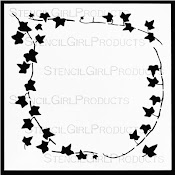
Ivy 6 and Ivy Frame 6 ...

http://stencilgirlproducts.com/new-stencils/view/721
http://stencilgirlproducts.com/new-stencils/view/722

... and Ferns 6 ...

http://stencilgirlproducts.com/new-stencils/view/723

Below is a greeting card cover I made with the Ferns 6 stencil in a technique described in an earlier post (using modeling paste, Distress Inks and rubbing chalk.)  I have used the same technique on a large botanical-themed collage, on gallery-wrap canvas, which I will be taking to my April 15 demo at Monmouth Festival of the Arts ... www.MonmouthFestivaloftheArts.com


Thursday, February 28, 2013

Monoprint using Ivy Stencil Now Available at www.StencilGirlProducts.com

In an earlier post I gave a list of web addresses that give beautiful demos on using a Gelli Plate for making monoprints.  Those other artists do a better job of explaining the process than I could, so I love that they are sharing their know-how online.  Above is a monoprint I made today, using a stencil that has just been released at www.StencilGirlProducts.com -- a 9"X12" ivy stencil, which has a just-released "sister" stencil of the same size:  an ivy frame.  These two 9"X12" stencils have "little sisters" in the 6"X6" size.  Although I used the 6"X6" ivy and the 6"X6" ivy frame stencils in making monoprints today, I like the larger version better for this particular technique.  

Saturday, February 23, 2013

Distress Inks applied directly thru my StencilGirlProducts stencil "Kaleid"

 
My stencil Kaleid -- newly available at www.StencilGirlProducts.com -- was used here with Ranger Industries' Distress Inks, applied through the stencil with an applicator that resembles that old-time shaving brush seen in Westerns.  (These applicators are called "Color Dusters" at www.SkyBluePink.com.) 

Friday, February 22, 2013

Just Posted at StencilGirlProducts.com -- my Stencil "Kaleid"

I'm dying to finish my first attempt at one of the techniques for stencil-use presented at Cindy Powell's blog --

http://cynthiapowell.blogspot.com/

-- but while my bottom coat of paint dries, I'll post two techniques for using Kaleid, the latest of my stencil designs (listed under "New Stencils") posted at www.StencilGirlProducts.com --

Below is a "ghost print" (the second print) I created using Kaleid and a Gelli Printing Plate.
There is a lot of online instruction on this type of monoprinting...

Using stencils is one way in which to use a Gelli Printing Plate or a homemade gelatin printing plate.   

Videos and other tutorial information can be found at these web addresses: 

Homemade Gelatin Printing Plates: 

http://printmakingwithoutapress.blogspot.com/2012/07/new-gelatin-printing-video-by-linda.html  (Note:  This video uses a variation of the technique I use.  The video mistakenly uses the word "stencil" -- and means to use the word "mask."   However, this technique-variation is worth a try -- using an actual stencil.) 

http://printmakingwithoutapress.blogspot.com/p/gelatin-printing-tips.html

(Note:  Lots of helpful info is on the above web page, if you are using a homemade gelatin printing plate.) 


http://cedarcanyontextiles.com/gelatin-printing-with-stencils-lesson-7/

(Note:  The above web address explains using stencils and gelatin printing plates with fabric.) 

youtube.com/watch?v=KRUMcgXK4UY

(Note:  In the above demo, the artist uses slow-drying acrylic extender mixed with her acrylic paints.  This is a common practice among printmakers.  Other options include "open acrylics" and printmaking inks; the latter come in oil-based versions and water-based versions.) 

Gelli Gel Printing Plates (which is what I used in creating the above example): 


****************
Another image I'm posting today is a greeting card cover:
 
 
The Shadow Knows!  To create an image like this, you will need a strong flow of light through a window, or use another source.  Find a way to secure a stencil in a position that results in its shadow being cast.  The shadow can be cast across a flat surface as shown above -- or across someone's face, if you want to create an unusual photo portrait!
 
After taking a photo of the Kaleid stencil's cast shadow, I printed it, cut it out with fancy-cut scissors and glued it to a greeting card cover.  On the lower right (difficult to see, here) I added a simple swirl of glitter glue.

Thursday, February 21, 2013

Another way to use a StencilGirl Products Stencil...

StencilGirl Products' stencils are easy to clean, even after using them with acrylic paints (if they are placed right after use into a soak basin of water) -- but since I was blessed to be accepted as one of the designers at StencilGirl Products, I receive not only each stencil itself for my own use, but also what called a proof -- a prototype, laser-cut from the same pattern I designed, using a lighter-weight and thinner sheet of acetate.  A proof can be used as a stencil -- but, being different in character from the finished product that is sent to a customer at StencilGirl Products, it will more readily retain a coating of acrylic paints, once it's been used with them.  The above proof was used in seveal applications and the proof itself has become so pretty that I've scanned it and will use the print-outs on greeting card covers.  The above image is darker and dimmer than the proof itself but serves well enough to show what I mean.
 
The latest stencil of mine to be posted at www.StencilGirlProducts.com,   this design is titled Kaleid (listed on the SCP website under "New Stencils.")  The original design appears below:
How did I arrive at this design?  My friend Mary Ann had the idea for us to create collography printing plates, so together we trooped down to Collingswood Flea Market to buy thin sheets of black foam, waste scraps from unknown industrial uses.  We cut up the foam into random shapes and (with heavy matte gel medium) adhered them to sturdy illustration board.  We used the same gel to coat the foam shapes and their backboard (on both sides) so as to make them waterproof and washable.  After they were dried, we used them to make prints; one of my prints was done in black and white, which I scanned.  I then used a program called Kaleidoscope Kreater to alter the original image.  My last step (in Photoshop) was the stencil-making process:  Removing stray pixels, creating stencil bridges, and cleaning up edges of lines.
 
Was it worth all that work?  Yes!  This has become my favorite stencil.  One of the abstract artworks that I've just finished made heavy use of this stencil and I like the results so much that this piece will be included among my 10 "portfolio pieces" to be placed in the mid-April Monmouth Festival of the Arts ...


Tuesday, February 19, 2013

Stencil Mania has been spawned by StencilGirlProducts!

My friend Cindy has done some beautifully creative artwork using stencils, including stencils I've designed that are now available at www.StencilGirlProducts.com.  Please visit Cindy's blog --

http://cynthiapowell.blogspot.com/

--to check out her techniques!  I'm in the process of doing just that, myself.  Hope mine will turn out as nicely as hers did!

Today another stencil of my design -- Swatton Grid Stencil-- has gone live at StencilGirlProducts.com --
I created this design by first visiting a children's playground -- camera in hand -- and crawling under the platform near the slide.  From a squatting position -- ouch! -- I took photos from beneath the mesh-like platform, pointing upward toward the sun.  Later, in Photoshop, I transformed one of these photos into a silhouette; I collaged together sections of the silhouette; and finally I did the pixel clean-up and the bridge-building to create a stencil. 

Since I love to create non-representational abstract mixed media art on canvas, this one is among my special favorites.  It's available here:
http://www.stencilgirlproducts.com/product-p/s077.htm

Tuesday, February 12, 2013

Happy Announcement -- I'm Designing for StencilGirlProducts.com

The stencil that I used to make this greeting card cover is one of a brand-new collection of stencils that I have designed for StencilGirl --
http://stencilgirlproducts.com/new-stencils
-- and although only two of my stencils are currently on display at the StencilGirl website, more will be appearing soon.

To make this greeting card cover, I used masking tape to secure the stencil to the card; then, with a plastic knife, I spread an even layer of super-heavy white gesso across the stencil.  I removed the stencil (and immediately placed it in a basin of water to keep the gesso from hardening on the stencil.  Be nice to your stencils, and they will be nice to you!)  After the gesso hardened, I went over it with several successive layers of acrylic paint, rubbing off some of each color as I went.  I brushed white liquid gesso around the edges after all the paint had dried.  I then painted the gingko leaves with gold metallic paint.  After cleaning the stencil with a soft old toothbrush and patting it dry between paper towels, I placed it over a piece of foreign newsprint which had previously been painted green.  I traced the left side of the largest gingko leaf, then cut it out and collaged it onto the leftmost leaf.

This will be one of the techniques I will be demonstrating at my demo at the Monmouth Festival of the Arts, April 15.  I'm so thankful to my friend Mary Ann, who has generously offered to help give the demo.

For more techniques using stencils, come September, check Amazon.com for the new book by Mary Beth Shaw.  Its working title is StencilGirl but should this change, search Amazon using her name.
 

Saturday, February 9, 2013

StencilGirlProducts.com -- Home of My New Stencils and Much More!

Gingko is the name of the above stencil, available at StencilGirlProducts.com 
Marbles is the title of the above stencil, available at StencilGirlProducts.com
Links is the title of the above stencil, available at StencilGirlProducts.com
Flowers V 1 is the title of the above stencil, available at StencilGirlProducts.com
 
 
StencilGirlProducts.com -- Home of My New Stencils and Much More!

Friday, February 8, 2013

A Technique using my KALEID Stencil available at StencilGirlProducts.com


Stencil, Gel & Chalk:
Secure the stencil to the substrate of choice, using masking tape.  (I recommend Frog Tape -- sold at Lowe's, Amazon.com, etc.) With a palette knife or old credit card, spread heavy matte gel through a stencil.  
Allow the gel to dry completely (several hours, give or take, depending on thickness of gel that was applied.)   

Rub blending chalk (not sidewalk chalk -- that's too hard) across the ridges of the dried gel. 

If desired, spray with a fixative like Krylon.  Or use dollar store hairspray.
The stencil used to create this artwork is available at StencilGirlProducts.com ...
to reach my StencilGirl web-page --
http://tinyurl.com/ae3x6us

Thursday, February 7, 2013

Turning One of my Favorite Designs into a Stencil -- Then Using It

I love the shape of gingko leaves so much that my husband bought a gingko to plant in our back yard.  Ever since, I've used its pressed golden leaves in collages, greeting cards, altered arts and lots more.  Back when I was designing art rubber stamps, I may even have used gingko leaves in designing one of those.  As soon as I decided to try out for a position with StencilGirl as one of their stencil designers, I chose ginkgo as one of my earliest patterns.

I scanned some of my favorite pressed, dried gingko leaves at 300 dpi and used Photoshop to reduce them to silhouettes.  Then began the cosmetic work -- a few years ago, when she introduced me to the designing of digital clipart, good friend Cindy Powell taught me that it's necessary to greatly magnify every image to rid it of all "stray pixels" and less-than-perfect edges. 

After cosmetics, the next step was to teach myself how to design stencils.  In no way was I good at it right off the bat, but I began to "think stencil" and in so doing, added "bridges" throughout every area of the newly created pattern.

The irony of what I was doing was with me every moment.  I, a stencil designer?  Why, I had seldom wanted to use stencils!   I associated them with the generation of women who happily created borders of flowers or kittens or the like, along the tops of their walls and the edges of their furniture.  The few times I had actually forced myself to approach stencil-use, I had frustrating results -- the paint wanted to leak every which way, making a mess.  And finally, as my interest in fine arts deepened, I asked,  "Why would I want to use a commercially available stencil?  I would only end up with art that was not entirely my own original work.  Besides, what's the point of just repeating what a thousand other people are doing, since everyone can get the same stencil?"

Well -- as has happened often before -- a day came when I had to eat my words.  I experimented to learn the right kind of paints and other media to use with stencils, for starters; but much more satisfying than that, I taught myself ways to use them that were original and unique to me.

Then came the moment when I asked,  "Since I love creating non-representational abstract artwork, where can I get stencils that will lend themselves to use in this direction?"  Not at my local A C Moore or Michaels, that was sadly for sure.  Thus was born the idea to start designing my own ...

While designing a collection of abstract patterns, I started to wonder whether any stencil-making company would like them.  Alongside that idea came the thought that I should create a portfolio that included not only the way-out-there abstracts, but also a collection of traditional stencil images --  so out trotted my gingko, ivy and a number of my other pressed and dried once-green treasures.

I hadn't really expected to use the gingko stencil much, myself.

Wrong, again!

Delighted to be included among the StencilGirl designers, and to receive my first batches of stencils made from my own designs, I had to play with everything!  Starting with gingko ...


...and one of my earliest experiments was to spread gloss gel medium through the stencil; then, while the gel was still wet, I sprinkled it with colored sand.  I chose to sprinkle a heavy layer of sand onto part of the pattern and a lighter amount on another part.

I was careful to immediately immerse my stencil into a basin of water until I could give it a gentle cleansing -- telling myself,  "Be nice to your stencils, and they will be nice to you!"

http://stencilgirlproducts.com/search-stencils-by-artist
is where you can find this stencil and lots more! 

Wednesday, February 6, 2013

How many ways are there to use a stencil?


Using my StencilGirlProducts Gingko Stencil ...
Here is another greeting card cover made with the ginkgo stencil that I designed for StencilGirl -- and this one was put together in way less time.  I masking-taped the stencil to my work surface, then placed foreign newsprint over the stencil.  Next, I peeled the paper wrapper off an oil pastel crayon.  Holding the newsprint in place with one hand, I used the oil pastel -- on its side -- to make a rubbing of part of the gingko pattern.  I then cut it out and glued it to a background paper which had been created long ago as a "paint catch-all" paper during one of my painting sessions.  Quick and fun!
 
How many ways are there to use a stencil?  Find out in September when Mary Beth Shaw (the StencilGirl herself) will show up once again at Amazon.com, this time with a brand-new book that explores lots of answers to this question!  The book's working title is StencilGirl ... but if that should happen to change, you can still locate her new book, come September, by doing a book search at Amazon.com using Mary Beth Shaw's name.

Tuesday, February 5, 2013

Stencil Storage

There are a number of expensive cabinets and the like for storing stencils -- but one look around my studio/office reminds me that adding one more piece of furniture would require either hanging it from the ceiling, blowing out one of the walls, or ... need I go on?  But I do have built-in book shelves (that and the lighting are the reasons I love this room, which started life as the master bedroom.)  For me, then, the answer is 3-ring looseleaf binders filled with clear page protectors.  A recent Internet search showed me that others have adopted the same idea. 

Since  www.StencilGirlProducts.com and other makers of artists' stencils provide a range of choices as to stencil size, from small to large, I've decided to use the 12" X 12" binder-style "scrapbooks" available at places like (brick-and-mortar) Tuesday Morning and (online) Staples.  At the Staples website, I had to do some serious hunting, but finally found a reasonably priced product.  I don't need a binder with metal tips nailed to the corners -- yes, a true scrapbook is meant to last for generations; but immortal stencils ...?  By the time I'm gone, my beloved stencils will probably be so well-used that they may as well be placed alongside my body in the box.

Friday, January 11, 2013

2013 Monmouth Festival of the Arts

I was delighted to be accepted into the 2013 Monmouth Festival of the Arts, April 13 - 17, in the Fine Arts category.  I won't know which of my six submissions will be on display until that information is posted --
http://monmouthfestivalofthearts.com/
-- in mid-month.  But I do know it's time to choose some of the possible pieces to include among the allowed 10 portfolio pieces ... meaning that they will be wrapped in acetate and displayed in portfolio bins at the show, rather than wired for hanging.  One to three of my original six submissions will be on display as hanging art on the walls of the gallery.  And everything, of course, is to be labeled.  I need to finish the preparations as soon as possible since I have another event coming up that will keep me occupied for awhile, prior to the festival.

Last year I was saddened to be passed over in the MFA, although I am glad that artists need to jury in there every year, each year with a different juror making the selections, so as to keep the quality of the artwork high, as well as to reflect a variety of artistic tastes.  But then, less than a week ago, I learned that Jane Lux had also been passed over by last year's Fine Arts juror -- a discovery that nearly loosened my teeth.  Jane Lux is a top-drawer watercolorist and her favorite subject, flowers, is a forever-favorite among collectors.  Her website --
   http://janelux.com/Gallery.html
-- gives a glimpse of her exceptional skill, but as is often the case, seeing her artwork in person is an experience that allows the viewer to fully appreciate the nuances and subtlties that make her artwork truly gorgeous.  Her colors glow like jewels.

During the two college years that I spent majoring in commercial art (now called graphic art) I did just enough watercolor painting to realize how very challenging this medium can be.

I have no doubt that this year, when I check the MFA website next week, I will find Jane's name right where I feel it deserves to be -- among the listed artists whose work will appear in the 2013 festival.

Monday, December 31, 2012

Mary Beth Shaw -- StencilGirl and her book

Flavor for Mixed Media: A Feast of Techniques for Texture, Color & Layers, by artist and StencilGirl Mary Beth Shaw, sits on my sagging bookshelf within easy reach.  I haven't kept all of books I've bought on the subject of mixed-media art-making -- and I've skipped buying some of them altogether -- but this one definitely made the cut.  I  never open it without finding new inspiration.

In the "small world" category of things, I recently learned -- soon after deciding to create my own original stencil designs -- that this same Mary Beth Shaw is the artist who created StencilGirl ... http://stencilgirlproducts.com/ 

To my delight, Mary Beth has welcomed me to join the fabulous and creative team of artists behind the stencils already displayed on the StencilGirl website.

As the New Year begins, I'm looking forward to posting images of my StencilGirl designs here on this blog.  They will be available directly from StencilGirl.

Having already purchased StencilGirl products and put them to use, I can happily vouch for their quality.  They are sturdy enough to stand up to the less-than-gentle treatment that my unfortunate art-making tools must endure.

A peace-filled New Year is my wish for everyone out there!  

Saturday, December 29, 2012

Pat Dews -- a beautiful soul


I was unable to attend either of the 2012 Pat Dews' wokshops for which I had registered, but that disappointment was followed by Pat's kindly personal invitation to meet her at a recent award ceremony of the New Jersey Watercolor Society, which now -- fortunately for me -- meets in my figurative backyard, at Middletown Arts Center. (If you live in NJ and take NJ Transit from any of the Shore Points to NYC, you ride past this art center every time you pass the Middletown Train Station. These two buildings are rock-throwing distance apart. Not that I'm suggesting you throw any ...!)

My art-world experience was launched in college, in the prehistoric days before popularized computer use, when my major was labeled "commercial art." ("Graphic design," I think, is the modern label.) My focus during that era was representational art. By 1995, however, I had been bitten by a different bug and came down with a full-blown mania for nonobjective abstract art using mixed media. The fever has never gone down.

Thanks to creative minds like Pat Dews', it never will.

http://www.patdews.com

Tuesday, November 27, 2012

A Happy New Discovery -- StencilGirl Stencils


Although I was unable to attend either of the 2012 Pat Dews' wokshops for which I had registerd, nonetheless, signing up for them rekindled my fascination with play-tools used in mixed-media art-making.  This interest was heightened by Pat's kindly personal invitation to meet her at a recent award ceremony of the New Jersey Watercolor Society, which now -- fortunately for me -- meets in my figurative backyard, at Middletown Arts Center.  (If you take NJ Transit from any of the Shore Points to NYC, you ride past this art center every time you pass the Middletown Train Station.  These two buildings are rock-throwing distance apart.  Not that I'm suggesting you throw any ...!)

Not long after meeting Pat -- voila! -- I came across the most happy discovery of StencilGirl stencils, the brain-child of Mary Beth Shaw, whose name was already in my vocabulary since I often refer to her book on mixed-media artmaking.   I placed my order and quickly received high-quality plastic stencils that my fingers are itching to use.

My art-world experience was launched in college, in the prehistoric days before popularized computer use, when my major was labeled "commercial art."  ("Graphic design," I think, is the modern label.)  My focus during that era was representational art.  By 1995, however, I had been bitten by a different bug and came down with a full-blown mania for nonobjective abstract art using mixed media.  The fever has never gone down.

Thanks to creative minds like those behind StencilGirl, it never will.


Sunday, July 10, 2011

Ideas for using digital clipart in your creative projects...

Ideas for having fun with CD clipart:

Once they've been downloaded at DigiScrapStation, these images can be easily reversed left-to-right, either in your photo-processing program or in your printing program; printing them “backward” gives you two sets of images for the price of one! The only exceptions are the images containing text. These cannot be flipped -- unless your creative impulse leads you into trying backward text just for the fun of it!

You can print in black-and-white, then add your own unique color combinations to the print-out. If your inkjet printer uses dye-based ink, add this personal color with dry media -- colored pencils, rub-ons, oil pastels, etc. If your printer uses pigment ink, you can use wet media like acrylic paint.

You can print on patterned paper. Best results will come from choosing a pattern that’s light in color.

Another option: Create a transparency by printing on the “right” (rough) side of a transparency sheet of film (available at office supply stores.)

Or, use the same transparency film to make transfers: In your photo-processing program or in your printing program, flip an image or text horizontally, making it “backward.” Print this reversed text and/or image onto the “wrong” (shiny) side of a transparency. (Prior to printing, adjust your printer’s ink flow; you want a light flow, since too much ink will create puddles that bleed and blur.) Handling the transparency carefully as it emerges from the printer, immediately place it – wet side down -- onto the receiving surface. Holding it in place with one hand, use the other to burnish from the top of the film, using fingertips or a bone folder.

Transfer-Making Note 1: Transparency films can be used over and over. Simply clean off the residual ink with rubbing alcohol and allow dry-time. One sheet of film, although it will grow stained, will nevertheless work just as well countless more times.
Transfer-Making Note 2: If doing several of these transparencies in a row, take a few minutes to clean your printer following manufacturer’s instructions which in most cases can be found on manufacturers’ websites.

***
For a totally new look, try printing on mulberry paper – here’s how:
Set up a sheet of ordinary printing paper for use as a “carrier sheet:” Add strips of two-sided removable cellophane along the edge that will feed into the printer.
If using a flat-feed printer, this should be the only taping necessary. If using a printer that requires the paper to make a U-turn or an L-turn as it’s printed, add one length of tape along each of the long-side edges of the paper, and a third piece of tape down the center of the carrier sheet.
Cut a sheet of translucent mulberry paper to the size of the carrier sheet and gently press it to the carrier, securing it onto the pieces of tape. As the printing begins, hold one hand gently at the end of the paper opposite the feeding end, to help guide it into the printer just in case this should happen to be necessary.
After your first print, you will know whether or not you would like to adjust the ink flow for printing on mulberry paper. My personal preference has been to use either the “medium” or “photo” setting. Sometimes the “photo” setting results in the residual image on the carrier sheet (after the mulberry paper is carefully peeled off) becoming background paper to set aside for a future project.

Mulberry paper prints have a delightful and uneven translucency that make them fun to use in layering techniques for collage. The edges can be left with the original straight-edge cut, or the paper can be torn along the edges, with beautiful frayed edges that increase the areas of texture in a piece of art.
When using mulberry paper prints in collage, I’ve had the most success using dry adhesives like glue sticks.

***

I’m sure you’ll enjoy working with my CD digital clipart as much as I enjoyed creating it!  Since I own copyright on these images, they are not to be re-sold.  However, they can be used on products to be marketed for personal financial gain, when credit for the clipart is given to http://heartworkbycecilia.blogspot.com.  Many thanks!