
Showing posts with label 9"X12" Twinship stencil. Show all posts

Thursday, September 3, 2015

Rubbing Plates, Flip-Flops & Stencils


Soon, if not already, the kids will be back in school, but the weather, for most of us anyway, will still be warm.  So, during this ultra-busy couple of weeks that I'm having, I'm re-running a special-favorite post ...

My friend Mary Ann Russo made a series of rubbing plates using my stencils, then used those plates to make prints/rubbings on fabric.   Next, Mary Ann and her granddaughter, Marissa, cut up some flip-flop synthetic sandals and, with a heat gun,  used the rubbing plates to make rubber stamps.  I used those rubber stamps in my artwork; I also borrowed those rubbing plates to make prints/rubbings of my own -- on paper.

Mary Ann's method called for cutting matboard (sturdy cardboard) into squares and rectangles slightly larger than the stencils and coating them  with water-thinned gel medium on both sides, and along all edges.  Coating with water-thinned gel medium is an optional step that Mary Ann took because she wanted the rubbing plates to be washable.

After the gel medium had dried, Mary Ann masking-taped the stencils in place on the coated cardboards and used a spreading tool to apply a mix of molding paste and acrylic paint thru the openings of the stencils.  (Acrylic paint was added to the molding paste to make the resulting 3D patterns easier to see.)


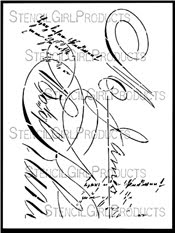
 Above is an example of one of my stencils -- 9"X12" Twinship -- being placed onto the rectangle of pre-coated matboard.


 Above, Mary Ann is placing the mix of molding paste and acrylic paint onto the stencil, which rests on the matboard.  Notice that she had secured the stencil to the matboard with strips of blue masking tape.  This tape also holds the matboard in place on her working surface.


Above, Mary Ann uses an old spoon to spread the mixture thru the openings on the stencil.

As soon as this step is finished, she lifts off the stencil --


-- and places the stencil to soak in a water-filled basin.  It will be cleaned later, when all the rubbing plates have been created.

 My preceding post launched me into the topic of rubbing/printing plates made by my friend Mary Ann Russo.  In that post, I detailed her process, using my 9"X12" stencil Twinship

Now, I'm showing another rubbing/printing plate made by Mary Ann.  This time, she used my 9"X12" stencil Vases.


The difference between this plate and the one featured in my Twinship post is that Mary Ann added one more step at the very end.  She covered the surface with two coats of a rubberizing spray to make it completely waterproof.

Household fix-it-yourself types are probably familiar with Napa Performix Plasti Dip spray.  Created to provide a non-slip, comfortable grip on tools and to provide protection against electrical shock and heat, it's available at SmileAmazon.com --
Originally, this spray came in red -- the color used in this project -- and now comes in black, clear and gray-translucent.  The spray is to be used outdoors and its first coat must be allowed to dry before the second coat is added. 
The finished plate can be used to make impressions on a paint-coated Gelli Plate, for pulling prints on paper or fabric. 
It can also be used in two other ways -- with a Shiva stick and fabric to make rubbings, as well as with acrylic paints to make prints. 
Today's post will focus on the last of these three options.
Above:  The work surface has been covered with freezer paper, shiny side up.  To the right of the plate are a rubber brayer and a dollop of heavy-body acrylic paint. 

Above:  I've rolled paint out across the freezer paper, rolling back and forth until the paint reached a tacky stage.

Above:  I've rolled the paint-loaded brayer across the plate.
 

 After coating the plate with this paint, I pressed a sheet of pre-painted newsprint over the plate, using both hands across the whole surface, to make sure all of the paper made contact with the plate.  Then I pulled the prints shown above and (with blue paint) below.

Thursday, February 26, 2015

Rubbing Plates used as Printing Plates


In yesterday's post, below, I described start-to-finish the process used by my friend Mary Ann Russo to create rubbing plates using stencils.  Mary Ann makes rubbing plates to use with Shiva sticks and hand-dyed fabrics.  I on the other hand use them to make rubbings on paper (see yesterday's post) or to make prints on "catch-all" papers.  (These are the foreign newspapers that I spread under artwork-in-progress to catch leftover acrylic paints; I clean my brushes on these papers before putting the brushes into water to be washed.  After a "catch-all" sheet has been used enough to have become a colorful background, it's then used for Gelli Arts prints or prints of other kinds.)

In today's post, I'll show 10 papers, all but one printed with acrylic paints and Mary Ann's rubbing plate created with my 9"X12" stencil Vases.  The first (purple) print below was made this way, on paper previously painted with the use of my 9"X12" stencil Twinship, which is visible as blue patterns of the background.  The second print (far left) was made with crayon -- after placing paper over the rubbing plate, I rubbed crayon across the top of the paper, picking up outlines of the raised shapes below the paper.

Crayon


For detailed information on creating these rubbing plates, just scroll down to yesterday's post, below this one.  Nine of the prints above were made by brushing acrylic paints over the rubbing plate, then pressing papers down onto the plate.  The rubbing plate was washed before paint could dry on its surface.

Sunday, October 26, 2014

KALEID shows up again...


My 6"X6" stencil Kaleid --


-- found at StencilGirlProducts --

http://www.stencilgirlproducts.com/product-p/s085.htm

-- came in handy when I was creating a collage for an online class I'm taking with Jane Davies.

With this stencil, I used a Gelli Plate and red acrylic paint to make a print on deli wrap.  When the print dried, I cut it into two pieces and added them to this work in collage and acrylic:

ABOVE:  A NARROW STRIP OF THE PRINT WAS USED IN THE UPPER LEFT ARM OF THIS CRUCIFORM, AND THE REST OF THAT PRINT WAS USED IN THE CENTRAL-RIGHT AREA.
It's not easy to find in the photo above, but the close-up below shows where I used another stencil-made print, elsewhere in the same collage. 


My substrate was a piece of polka-dotted black-and-white scrapbook paper.  With red acrylic paint and the Gelli Plate, I made a print on that paper with my 9"X12" stencil Twinship --


The results are subtle, since this print was made on a busy and finely detailed background paper, but subtle was what I wanted in this area of the cruciform, since it wasn't meant to be the focal point.

Monday, October 13, 2014

Rubbing Plates re-visited


Today's topic:  rubbing/printing plates made by my friend Mary Ann Russo.  In that post, I detailed her process, using my 9"X12" stencil Twinship

In today's post, I'm showing another rubbing/printing plate made by Mary Ann.  This time, she used my 9"X12" stencil Vases.


Above:  Mary Ann has covered the plate's surface with two coats of a rubberizing spray to make it completely waterproof.

Household fix-it-yourself types are probably familiar with Napa Performix Plasti Dip spray.  Created to provide a non-slip, comfortable grip on tools and to provide protection against electrical shock and heat, it's available at SmileAmazon.com --
Originally, this spray came in red -- the color used in this project -- and now comes in black, clear and gray-translucent.  The spray is to be used outdoors and its first coat must be allowed to dry before the second coat is added. 
The finished plate can be used to make impressions on a paint-coated Gelli Plate, for pulling prints on paper or fabric. 
It can also be used in two other ways -- with a Shiva stick and fabric to make rubbings, as well as with acrylic paints to make prints. 
Today's post will focus on the last of these three options.
Above:  The work surface has been covered with freezer paper, shiny side up.  To the right of the plate are a rubber brayer and a dollop of heavy-body acrylic paint. 

Above:  I've rolled paint out across the freezer paper, rolling back and forth until the paint reached a tacky stage.

Above:  I've rolled the paint-loaded brayer across the plate.
 
 After coating the plate with this paint, I pressed a sheet of pre-painted newsprint over the plate, using both hands across the whole surface, to make sure all of the paper made contact with the plate.  Then I pulled the print shown above.

Mary Ann used the same process with black fabric-printing paint to make the print below, on a piece of off-white fabric --


I used blue acrylic paint to print another sheet of pre-painted newsprint, as shown below.

Friday, October 10, 2014

Stencil-and-Scrape Technique, re-visited


Earlier, I've posted about a technique that I call stencil-and-scrape
-- on Jan. 4 , March 14 and April 2 --
where I've supplied numerous photos with directions. 

This technique is simply a wet version of the rubbings technique; traditional rubbings are done with soft-lead pencil or crayon, whereas I use acrylic paint and an old credit card. 

With masking tape, I secure a stencil to the work surface; then I tape a sheet of thin paper over that.  After adding a few dollops of acrylic paint to the top of the paper, I scrape the paint downward over the paper, pressing evenly to pick up the patterns in the stencil.

Just recently I made more stencil-and-scrape papers using my 9"X12" stencil Twinship.  Since I planned to use the finished paper in a multi-layered collage, I chose deli paper because it's thin; and its translucency allows underneath colors to show thru. Below is one of the completed papers.


After the paint dried, I cut the papers into shapes and added them to a collage on canvas, shown below.  To better see the stencil-and-scrape papers, click on the image --

Monday, August 18, 2014

Repeating Pattern Stencils -- Readymade and Customized


At http://www.stencilgirlproducts.com/category-s/1932.htm, you will find a new category-grouping of stencils:  Repeating Designs. 

A repeating pattern stencil enables an artist to lift the stencil after its first print, then place it back onto the printing surface and easily line it up with the earlier print -- to maintain even, seamless spacing of the overall finished design.  This can be done endlessly to cover a surface of any size.  It's commonly used by artists working in the fiber arts but it's gaining popularity among those into the paper arts, too.  I suspect the whole idea started back in ancient Egypt with hieroglyphic reliefs along the walls.

My stencils Quilted Flower Garden and Facets fall into this special new category.  Here's how the technique works:
Above:  Having made the first print (on the right) I've lifted the stencil.  In the upper left is the sponge dauber I used to apply the acrylic paint thru the stencil. 
Above:  I've placed the stencil down again, lining it up exactly with the first print.  I recommend using masking tape to get exact alignment.

Above:  I've lifted the stencil after making the second print.  Notice there is a space gap between these two prints.  I could choose to make the third, fourth, fifth, etc., prints with this same space gap between each print.  Or, I could approach the whole project, from step one, by eliminating that space gap.  To do that, I would simply overlap the stencil over the original print, as show below: 
Above is a distance shot, showing the stencil overlapping the original print along one edge.  Below is a close-up which shows this better.

I chose to make my second print using a color-blend that differed from the original print.  If I were to repeat this process again and again, I would continue to create color-blends across the entire printed surface, which could end up any overall size that I want.  But this is just an option, to create variety.  Repeating pattern stencils are often used with no variation in color.

Now that I've shown how the repeating pattern technique works, I'll show how some stencils easily lend themselves to customization, so they can be used in the same way. 

For example, you can create long narrow Repeating Pattern Stencils with my stencil Borders #1, simply by cutting this stencil into 3 equal strips.  Just place the stencil over a self-healing cutting mat pre-printed with a measurement grid.  The below photo, and its close-up that follows, show the stencil lined up with the measurements and grid-lines on the cutting mat.


Once the stencil is lined up where you want it, place a ruler where you want to cut the new stencil edge.  Use the mat's guidelines to keep the ruler straight and, with a Sharpie pen, draw a cutting line.  You can then lift off the stencil and cut it with scissors -- but better yet, for a perfect cut, you can leave the stencil and ruler on the cutting mat, and cut along the line with an X-acto knife.

Likewise, you can easily customize my 9"X12" stencil Wrought Iron Gate to make it a Repeating Pattern Stencil.  Just line it up on the cutting mat and cut off the "ornament" at the top of the "gate."  Below, I've used a ruler with a metal edge that will be useful in the next step, when I will use my X-acto knife to do the cut.  But for now, I'm just drawing the guideline for the cut:

Above:  I've placed the stencil onto the cutting mat, lining it up with the measuring grid pre-printed on the mat.  Those blue lines helped me place the ruler exactly where I wanted, to draw a line between the ornate "gate top" and the rest of the stencil.  This is shown better in the close-up below:

Click on the above image to enlarge it.  This will help you better see the ornate "gate top" that is to be cut off.

The above photo shows the ruler pulled away from the line that I've drawn.  The cut will be made here.
One important thing to note is that this stencil customization gives you an edge-free design.  This kind of raw-edged stencil is more fragile, but the lack of an outer border makes it easier to align prints side-by-side, for a seamless overall effect.

Stencils are tools to be personalized any way you want to achieve your unique artistic goals!

Monday, August 11, 2014

In a Green and Blue Mood ...


Awhile ago I made some Gelli Plate prints with acrylic paints sponged thru my 9"X12" stencil Queen Anne's Lace ...

 
Above is a print that I did on top of an earlier print that I had made using my 9"X12" stencil Twinship with the Gelli Plate.


After I'd made the two prints above, my stencil had a build-up of black acrylic paint around the flower shapes.  While that paint was still wet, I flipped the stencil over and used it as a "stamp" to imprint a sheet of acrylic paint-coated newsprint...


Tuesday, July 8, 2014

Gelli Plate Adventures


The Gelli Arts Plate got some more use recently.  I'm slowly discovering the reasons I've had problems getting prints that satisfy me.  One mistake I've made has been to press too hard with the brayer when spreading the acrylic paint across the plate.  Next time I use it, I plan still more changes to try. 

Meanwhile, here are some recent prints:

Above:  2 stencils used at the same time -- 6"X6" Cats was first onto the plate and 9"X12" Twinship was atop it.  I lifted both stencils off the plate, leaving their impressions in the paint, then pulled a print.

Above:  Barely visible on the left is an old print of 9"X12" stencil Queen Anne's Lace ; more visible, especially on the right, is 9"X12" Wrought Iron Gate.

Above:  I used Wrought Iron Gate stencil to make a print on a sheet of foreign newsprint.

Above:  I used 4"x4" Fern Fronds Silhouette like a rubber stamp to make this print, right after lifting the still-wet stencil off the plate.
 
Above:  2 stencils were used at the same time -- 6"X6" Heron was placed on the plate first, then 9"X12" Twinship was placed over it.  Next, I removed both stencils and pulled the print.