
Thursday, January 5, 2017

Silkscreening with Stencils!


Today's post focuses on a kitchen towel applique project as well as other silkscreened artwork created with stencils; it was made possible with the help of Cindy Powell and Mary Ann Russo.


Above are two of Mary Ann's kitchen towels showing Mary Ann Russo's silkscreen printed fabrics used as appliques on a set of kitchen towels.

Above: a close-up detail of of one towel.  Both silkscreen prints were made with my 9"x 12" stencil Mimosa.

Above is a finished mixed-media collage of mine; the bottom layer of its background was silkscreen-printed onto canvas fabric using my Vases 9"X12" stencil.

This write-up is based on the works of many other artists who have shared their experiences and photos online, in books and in DVDs. These pioneers have broken the trail for fabric artists like Mary Ann Russo, whose lovely kitchen towels are pictured above, and Cindy Powell, whose photos will be used in the first section of this write-up.


One advantage of pairing a stencil with a silkscreen is that the same framed screen combo can be used over and over, to create repeat patterns on the same fabric.  This approach is quicker, less costly and less involved than the alternative of using multiple silkscreens, each created with its own single, permanent design. 


Another reason for using a silkscreen with a stencil is that the screen protects the stencil. The heavy pressure that is sometimes required for ink-application could damage stencils with intricate, delicate designs -- but, with this technique, the ink is never applied directly to the stencil. The framed silkscreen mesh is a porous yet protective barrier between the squeegee that spreads the ink and the cut-outs that form the design. Thus, the stencil remains totally intact, ready for use in any of the other multiple ways available to multi-media artists.


Supply list:


(1) T-pins and sturdy tape such as duct tape

(2)  scissors

(3) a large padded work surface, covered with protective plastic sheeting

(4) a second work surface, covered with newspaper

(5) a wide basin half-full of clean water

(6) a length of fabric --

100% cotton is a popular choice.  This cloth must first be washed in hot water to remove sizing, then machine-dried, using no drier sheets or any other form of fabric softener.  It must then be stretched taut across the padded surface, and secured there with T-pins (corsage pins) or sturdy tape.  
 (7) a stencil

With this technique, a stencil is what gives the artist the design to be printed. For this project, Cindy Powell is using the 9"X 12" Mimosa stencil.

 (8)  painter's tape 

     Painter's tape (a low-tack tape such as blue masking tape) is used to secure the stencil to the silkscreen frame.

(9)  fabric-printing ink and a plastic spoon or any similar tool 

     One popular ink is Speedball fabric screen printing ink; one source of this ink is
(10)  squeegee 

      This tool has a sturdy handle and a soft-plastic edge.  One example:

(11)  silkscreen

     A silkscreen consists of a frame, often aluminum or wood, which encases a tautly-stretched piece of mesh (originally made from silk but currently made from synthetics like polyester/organza.)  It's important to use a silkscreen large enough to accommodate the 9"X 12" stencil with enough leftover space along one edge for placing the streak of printing ink (which will be spread across the stencil.)  Below is a silkscreen viewed from the top (also called "the inside") --  it shows the white central area, which is sunken; this part is called "the well."


The above photo is courtesy of Cynthia Powell 

As you can see, for this technique, the artist uses a screen containing no previously established design -- so this screen can be considered a "blank."

The other side of this silkscreen has no indentation/well; it has a flat surface that will be placed upon the fabric -- after that flat surface has had the stencil attached.

To attach the stencil to the silkscreen:  Lengths of painter's tape are firmly pressed all the way around all four edges of the stencil, creating a snug fit on the side of the silkscreen that will be placed onto the fabric to be printed. The painter's tape must cover the entire area between the outer edges of the stencil and the outer edges of the silkscreen, since the artist wants no ink to print in these outer areas. 
Having taped the stencil to the silkscreen, the artist places the un-inked screen on a flat sturdy surface covered with newspaper.


In the above photo, viewed from the "well" side of the silkscreen, you can see the 9 X 12" Mimosa stencil through the thin mesh fabric.  The center-area stain is not going to print.  It is permanent, the result of a previous silkscreening project.


Now, the artist adds a stream of the thick ink into the sunken area, "the well," on top of the silkscreen -- the side opposite the flat side where the stencil has been added.  When placing this stream of ink onto the silkscreen, the artist is careful to place it along one taped edge, keeping the ink on the tape, to avoid getting ink onto the stencil which can be seen through the mesh.  Excess ink would make the ink pool, flooding the stencil to create a blob-print instead of a print with well-defined design.

The artist then uses the squeegee to make four or five passes across the silkscreen, to saturate the screen.

Next, the artist lifts the screen to see whether a good print has been made on the newspaper.


When the print has passed that test, the framed silkscreen-stencil-combo is then placed onto the fabric -- and it's time to make the final prints.


Mary Ann Russo, an experienced silkscreen user, makes her prints working alone.

Some other silkscreen users recommend that at this point, two people should work together -- one holding the screen securely in place, while the other makes multiple passes with the squeegee across the screen. 


It can take at least four passes with firm pressure from top to bottom, and side to side, to get the ink to penetrate the fabric. 


(Still other silkscreen artists use the Provo Craft Yudo machine, which comes in several versions with corresponding price ranges; this machine makes it easier for one person to do the operation alone.   One source: 


Once the first print is completed, the artist lifts her screen and sets it aside on clean newspaper. 


Above is a close-up of a just-completed silkscreen print, done by Cynthia Powell, using the 9" X 12" Mimosa stencil.  Note the reflected light on the left side, indicating the ink is still wet.
If the artist wants to make more prints on the same piece of fabric, she must first use a hair drier to dry the just-printed section.

As soon as the printing is finished, the stencil is un-taped from the screen and both are placed in a basin of water until time allows gentle cleansing away of the ink. Some artists work outdoors so as to cleanse the screens and stencils with water from a hose.
The printed fabric is allowed to dry overnight.  Then the artist heat-sets the prints with an iron, following directions supplied by the ink manufacturer.

No further washing is needed; the fabric is now ready to be cut into shapes for use in appliqué-making.  

To learn more about appliqué-creating and application, many online tutorials are available. Below are just a few of the possible choices:


To shop for a DVD giving detailed silkscreening instructions, here are just a few of the many choices out there:

Below are examples of my layered-look artwork incorporating stencil-prints on fabric: 


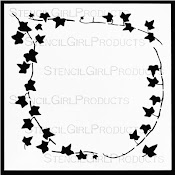
This close-up detail shows canvas having been silkscreen printed with one of my 9" x 12" Ivy Frame 9 stencil.


The above photo shows canvas fabric silkscreen-printed with my 9' x 12" Vases stencil.  This print was made on the original white canvas.  After drying the print, I brushed on a thin layer of translucent acrylic paint.  The finished mixed-media collage is shown at the start of this post.

Tommy McDonell Returns!


Sadly, there are people who are actually afraid of color!  Oh yeah.  I know of one person whose home is completely white indoors -- walls, floors, furniture -- for this very reason.

But artist Tommy McDonell is not one to fear color!  She uses it with wonderful abandon.

Wanna see?

Above:  a close-up detail of an artwork by Tommy in which she used a variety of beautiful StencilGirl stencils, and, making me very happy, included among them my 9"x12" stencil Wrought Iron Gate.  

Above:  another close-up detail of an artwork by Tommy in which she used a variety of gorgeous StencilGirl stencils, and, to my delight, included among them my 9"x12" stencil Wrought Iron Gate.  


Above: In a aclose-up detail from a different artwork of Tommy's, the white imprints in the upper left and lower right were made with one of my two stencils Palm Fronds Silhouette, which comes in 2 sizes -- 6"x 6" and 4"x 4"


Above:  a full-sized artwork by Tommy that again has imprints from my Wrought Iron Gate stencil, among other gorgeous stencils from StencilGirlProducts.com.  

Tommy tells me that Wrought Iron Gate is one of her StencilGirl favorites because it holds up well even when covered with lots of heavy media!  

The stencil itself looks like this:


Other stencils of mine that Tommy used above are --


And Palm Fronds Silhouette Mini (4" x 4"):


Be sure to catch up with Tommy McDonell here--

Facebook:  TommyBuellMcDonellArt 

And here –
Tommy’s website:  tbmcdonellart.com


Monday, January 2, 2017

More TANGLED PODS!


Tangled Pods remains one of my all-time favorite 9" x 12" stencils.  I find myself reaching for it often -- to do experiments.  Below are some of my recent results:


Since I'm experimenting, none of these is a final piece.  I want to keep trying new things to see what happens!  

Saturday, December 31, 2016

Annie Hamman and TANGLED PODS


The busy hands of artist Annie Hammond have come up with a very creative way to use my 9"x 12" stencil Tangled Pods --


The above image is a close-up detail from a larger artwork by Annie, made with other StencilGirl stencils in addition to mine.  

Tangled Pods itself looks like this:


Thanks for visiting my blog!

Wednesday, December 28, 2016

Mary Ann Russo's Art Journal and WROUGHT IRON GATE


My friend Mary Ann Russo has chosen a vintage theme for her artwork/journal-in-progress, and to my delight, she's been using a number of my stencils along with Golden's flexible Molding Paste and acrylic paints.  Her art -- done on a heavy-grade, cold-press watercolor paper -- will start appearing here in today's post; I'll be adding more posts later.

The three photos below show a two-page spread that features a set of cut-out windows (both of which frame prints from vintage postcards.) The first two show close-up detail, while the third photo shows the full two pages.   


The 9"x12" stencil that Mary Ann chose to use is Wrought Iron Gate.  The stencil itself looks like this:


Many thanks to you, Mary Ann, for allowing me to post your gorgeous artwork here!  

Lots more to come!   

Monday, December 26, 2016

Frieda Oxenham with CLUSTERED LEAVES and LOOPY LADDERS


United Kingdom artist Frieda Oxenham has created a new art journal that's filled with her stunning stencil-printed papers.  She has used a number of StencilGirlProducts.com stencils, and I'm delighted that among them were two of my 9" x 12" stencils, Clustered Leaves and Loopy Ladders.  


Above:  CLUSTERED LEAVES stencil was used with blue paint to help form an integrated background.


Above:  CLUSTERED LEAVES and LOOPY LADDERS were among the many stencils from StencilGirlProducts.com that artist Frieda Oxenham chose for these pages, which were then sandwiched into Frieda's beautiful new journal.

Clicking on Frieda's name above, you can visit her blog.  My sincere thanks to her for letting me use these images here!

The two stencils featured in this post are:


Above:  CLUSTERED LEAVES (9" x 12")

LOOPY LADDERS (9" x 12")

I appreciate your visit to my blog!

Monday, December 19, 2016

Sneak Preview -- New Christmas Card


Mid-January, I'll have the honor of guest-posting for StencilGirlTalk. Here is a Christmas card made with the technique I'll be showing in that post:


In that guest-post, I'll be showing other-occasion greeting cards, as well, along with step-by-step photos and instructions.  It's a technique I learned online, and was won over by its use of foil -- along with it being quick and easy!  Altho I've employed it to make greeting cards, it can be used in art journaling, both as cover decoration and as embellishment on journal pages.

The stencil used to create the embellishment on the upper left is my 6" x 6" Kaleid.  The stencil in its entirety looks like this:


Merry Christmas to everyone who celebrates this special day!

Monday, November 28, 2016

NOVEMBER 28 CYBER MONDAY Sale at www.StencilGirlProducts.com!


Stencil savings up to 35% on my stencils!

Official shopping details: www.stencilgirlproducts.com

Save 25% off all* stencils
Use code: cyber25 
Monday, November 28, 2016
from midnight until 11:59 a.m. CST (Central Standard Time)
PLUS 10% discount when you buy 6 stencils of the same size!
AND orders over $100 get a FREE large stencil of Mary Beth's choice!
SHOP http://www.stencilgirlproducts.com/stencilgirl-products-s/1846.htm

Save 20% off all* stencils
Use code: cyber20
Monday, November 28, 2016
from noon until 11:59 p.m. CST (Central Standard Time)
PLUS 10% discount when you buy 6 stencils of the same size!
AND orders over $100 get a FREE large stencil of Mary Beth's choice!
SHOP http://www.stencilgirlproducts.com/stencilgirl-products-s/1846.htm

Please feel free to share the news about our sale!

Thank you for being a person who loves stencils like we love stencils!

*Stencils only. Does not apply to DVDs, books, tools, wholesale orders, or gift certificates. StencilClub exclusive monthly member discount does not apply.

Here is a link in case you need to check your time zone against St.Louis, MO: 
https://www.timeanddate.com/worldclock/personal.html


And here is the link to my StencilGirl page -- 

http://www.stencilgirlproducts.com/stencils-cecilia-swatton-s/1832.htm

Enjoy shopping the sale!

Saturday, November 26, 2016

Cyber Monday Sale is Coming at StencilGirl!


November 28 will be a special sale day at StencilGirlProducts.com!

Details will appear here early on November 28.

Thursday, November 17, 2016

TANGLED PODS and PRAYER FLAGS


Look at the smile glowing on the face of this participant in a workshop earlier this year, facilitated by Carolyn Dube!


I'm delighted that my 9"x 12" stencil Tangled Pods was the StencilGirlProducts stencil used here.

I don't know which technique Carolyn was presenting here, but it reminds me of a few Gelli Plate prints that I once did in an online workshop with Jane Davies...


Stencil used:  Tangled Pods.

Stencil used:  Prayer Flags.

 
http://www.stencilgirlproducts.com/stencil-prayer-flags-cecilia-swatton-p/l371.htm


Thanks for visiting!

Monday, November 14, 2016

Tommy McDonell Again -- and PALM FRONDS SILHOUETTE SMALL


 This image by artist Tommy McDonell is enough to knock any art-lover off his feet!


My guess is that Tommy used alcohol inks on Yupo (a slick, synthetic substrate that comes in a choice of thickness, as does watercolor paper.)  What a stunning work of art!  My hat's off to you, Tommy!

The stencil used here was Palm Fronds Silhouette Small --  which measures 6"x 6" -- and which has a little sister, Palm Fronds Silhouette Mini -- measuring 4" x 4".  I've often used the two stencils together, really happy with the way that something as simple as two sizes can help create variety while maintaining overall unity within an artwork.


Again, let me announce that you can catch up with Tommy McDonell here--

Facebook:  TommyBuellMcDonellArt 

And here –

Tommy’s website:  tbmcdonellart.com


Friday, November 11, 2016

Tommy McDonell with SILHOUETTE OF A WILDFLOWER BOUQUET


Artist Tommy McDonell has created three jazzy prints that grabbed my attention -- especially the top one, below:


I'm honored to say that Tommy's prints were made with my 6"x
6" stencil Silhouette of a Wildflower Bouquet --


You can catch up with Tommy McDonell here--

Facebook:  TommyBuellMcDonellArt 

And here –

Tommy’s website:  tbmcdonellart.com

Tuesday, November 8, 2016

Frieda Oxenham


UK artist Frieda Oxenham has been working in her art journal ...


Above:  a 2-page spread while Frieda's artwork was still in progress.


Above:  a close-up detail of the wonderfully complex, multi-layered finished artwork.

Among the many StencilGirl stencils that Frieda chose to use for this project, I'm happy she chose to include one of mine --

Pressed Leaves, which measures 6" x 6" and looks like this:


My sincere thanks to Frieda for allowing me to post her artwork here!

Friday, November 4, 2016

More Combos!


I have still more combinations to show; the top photo is a close-up detail and the second photo shows the full piece.  All four were made with the same two 9"x 12" stencils -- Mimosa Stencil and It's a Jungle Out There.


More combos tomorrow ... 

Wednesday, November 2, 2016

Butterfly Wings with IT'S A JUNGLE OUT THERE


Butterfly Wings is the the title that I decided to bestow on this painting on stretched canvas --


You can click on this photo to enlarge it and better see its details.  

On the far left, middle section and far right, I've made imprints using cut-out sections from one of of my October 13-released 9"x 12" stencils, It's A Jungle Out There

The stencil itself looks like this:


Thanks for visiting!

Tuesday, November 1, 2016

Nancy Sanderson Curry and CLUSTERED LEAVES


I'm happy to interrupt my ongoing string of daily posts about my 3 Oct. 13 stencil releases, so I can offer this treat!

Nancy Sanderson Curry has delighted me in making this video --


-- and I'm so glad that, from all the beautiful StencilGirl stencils, she chose my 9"x 12" Clustered Leaves ... and with it, she created art to envy!  

The stencil itself looks like this:


Many thanks to you, Nancy!

IT'S A JUNGLE OUT THERE and the Chop-Shop


The first four photos below are close-ups of several areas on a painting on stretched canvas.  The fifth photo shows the piece in its entirety.


The stencil I used repeatedly on this piece is my 9" x 12" It's A Jungle Out There.   And, as you probably can tell -- by clicking on the above image to enlarge it -- I had cut the stencil into three or four pieces before using it here.

Before it went to the chop-shop, the stencil looked like this:


The first stages of this artwork was done following a technique found in the Absentee Artist Chapter of the book Creative Paper Art by Nancy Welch; it's also shown on Pat Dews' DVD Designing Great Starts with Texture and Form, available online at Cheap Joe's Art Supplies.

In the middle stage, I used paint-tinted white gesso around the edges to strengthen the composition. 

The final stages of this piece were done with oil-based art crayons. 

Thanks for visiting!

To see all my stencils, please go here.