
Tuesday, June 18, 2013

A Marriage of Stencils and Fabric Arts


My friend Mary Ann Russo decorated each of these dishtowels with an applique made from a fabric print, having first created each print by using one of the stencils I've designed, the 9"X12" version of Mimosa --

Find this stencil here...

Mary Ann's method:  She used Speedball Silkscreen Ink For Fabric to make the print, having first attached the stencil to her silkscreen.  She could have opted to use fabric dye, but she has found that if the artist wants a highly defined dark image, fabric paints or silk screen inks do a better job.
 
This is a close-up of the applique; click on the image to enlarge it.

These are the two finished dishtowels -- too pretty to use!  Click the image to enlarge it.
 
 And check out all the other fine stencils at ...

www.StencilGirlProducts.com.
 

Saturday, June 15, 2013

Dimensional Stenciling

My latest email from Seth Apter carries news of a new ebook, very attractively priced at $1.99, on the topic of using stencils to create dimensional imagery.  The place to purchase and download it is:

http://www.interweavestore.com/art-lesson-volume-6-dimensional-stenciling
 

Monday, May 13, 2013

My Second EBook Publication...

... is now available for purchase via the following link:

www.awalkintoabstracts6.com

My special thanks to Sue St. John for having invited me to submit artwork for inclusion in both the above Volume 6 as well as her earlier publication, Volume 5:    http://AWalkIntoAbstracts5.com
Sue's ebooks are always a delight to see and to study.  Highly recommended for lovers of nonrepresentational artwork!

Monday, April 22, 2013

Stencil Updates from Here and There

Last week's stencil demo at the Monmouth Festival of the Arts went very well.  My friend Mary Ann co-demonstrated with me, and I was especially delighted with her idea of making a rubber stamp-style printing plate, using the 9"X12" Jugs stencil that I designed for www.StencilGirlProducts.com.  I will be posting photos when they are available.  (Mary Ann had to go straight from our demo to preparing for the Allaire Flea Market, held yesterday.)

Already available for pre-order at www.Amazon.com, Mary Beth Shaw's   book StencilGirl is stuffed with even more ideas.  I've placed my pre-order and look forward to receiving it this fall.

I just ran across a delightful blog --
http://jessicasporn.blogspot.com/2012/12/test-driving-hebrew-calligraphy-stencil.html
-- abrim with even more stencil-using ideas; its author is a fellow designer for StencilGirlProducts.  IMPORTANT NOTE:  The author's name is Jessica Sporn.  Please don't get the idea that her blog title refers to anything other than her name!!!  (Blush.)

Wednesday, April 10, 2013

Repeating Designs in Abstract Fine Art thru Stencil Use


Above is a close-up of a mixed-media collage I will be bringing to my April 15 demo at Monmouth Festival of the Arts ...

http://monmouthfestivalofthearts.com/festival-information/brochure/

... wherein I will show a number of fine-art applications using stencils from StencilGirlProducts.com.

Like many of the techniques I use, this one that I call "stencil-and-scrape" is not entirely original.  I did discover it by way of happy accident -- but shortly afterward, I saw that someone else had made the same discovery and posted it on the Internet.

After using masking tape to secure a stencil to my substrate, I use more tape to add a sheet of translucent paper over the stencil.  I use deli wrap paper, but tracing paper or many other substitutes will work as well.  With a credit card or an artist's spatula, I then scrape acrylic paint over the paper atop the stencil.  This is simply a "wet" version of making a rubbing, an old technique that I described in a much earlier post.  It is much faster and easier than the traditional dry rubbing method.  When I do it, I'm careful to stroke the loaded scraper in one direction only.  I use several strokes, moving from left to right across the paper atop the stencil.

I remove the translucent paper and set it aside to dry.  After dry-time, I cut it into desired shapes and add it to my mixed-media collages, as shown above:  The far left shows a paper that was scraped over my Kaleid stencil, using a combination of gold and white acrylic paints.

The pink middle section was created with one of my other favorite stencils from StencilGirlProducts.com, using the tried-and-true method of simply sponging on paint thru the stencil's openings.

The aqua right side was created with the addition of a second dried piece of "stencil-and-scrape" paper, this one having been scraped with aqua acrylic paint.

The over-stamp of gold paint on the right side of the photo was a "ghost print" --  elsewhere on the same artwork, I had just used a stencil in the traditional way of applying (gold) paint thru a stencil with a sponge-topped stipple brush.  While the leftover gold paint on the stencil was still moist, I pulled the stencil off the substrate, flipped it over and pressed it to this area, over the aqua collage paper.

This ghost print method is a form of monoprinting, stamping and transfering; I've seen all three labels applied to it.  It keeps paint-waste to a minimum and it serves the purpose of helping create unity in the artwork by repeating a pattern ... doing so without using the exact same image, which could become boring to the viewer's eye.  The flipping over reverses the original image; the fact that the paint is just leftovers creates the "ghost" effect, which further changes the design in a way that is likewise subtle.  I like to make my artwork interesting in every part of the surface -- not equally interesting; I almost always want the focal point to stand out -- but I do want to "entertain the eye everywhere," to borrow a wonderful phrase from some other artist whose name I wish I could remember!

Altho it may not be immediately apparent, the gold ghost print was created using the same stencil (my Kaleid stencil, available at www.StencilGirlProducts.com) as what had been used earlier in creating the "stencil-and-scrape" collage paper on the far left.  The viewer's eye may not immediately grasp this similarity, but the vaguely similar pattern will give the viewer a sense of satisfaction.  The goal of unity in an artwork is, I think, to achieve this satisfaction.

Stencil-Use in Mixed-Media Collage


Above is a close-up of one of the mixed-media collages I will be bringing to show at my April 15 demo at Monmouth Festival of the Arts...

 
... and it shows two uses for art stencils that I will be covering in my demo:   The left side of the photo, as well as the white-and-blue over-print on the right side of the photo, are examples of simply spreading a thick medium thru a stencil that's been secured to the substrate with masking tape.  The medium I chose for this piece was molding paste/modeling paste (one manufacturer uses one name and another uses the other; yet another company calls it "artist's cement.")
 
The upper right area of this photo shows embossed "paper" that I made using one of my favorite stencils from StencilGirlProducts.com.  Please scroll down to my March 6 post to read the technique used to create this embossed "paper." 

Wednesday, April 3, 2013

Stencils are Fun!


One of my favorite fellow designers at StencilGirlProducts.com, Daniella Woolf, has created a 9"X12" stencil entitled Calligraphy -- which I have used many times.

http://stencilgirlproducts.com/stencils-9x12/view/691

Because I've been too lazy to follow my own advice for cleaning stencils after use with acrylic paints and other acrylic media, I've created a mixed-media patina on the original stencil ... and I like it so much, I've scanned it.  I plan to use it as an overlay or a background in future digital artwork.
And, you know, I'm tempted to cut up this particular stencil -- after ordering a replacement! -- and use it as part of a collage. 

Stencil News

Available now for pre-order at Amazon --

http://www.amazon.com/gp/product/1440330174/ref=as_li_qf_sp_asin_tl?ie=UTF8&camp=1789&creative=9325&creativeASIN=1440330174&linkCode=as2&tag=thealtpag-20

While waiting to receive that all-stencil book by Mary Beth Shaw -- well worth the wait; to my knowledge, there is no other book out there focusing exclusively on the variety of ways to use stencils -- you may want to check out page 133 in another book, Mixed Media Revolution, by Darlene Olivia McElroy and Sandra Duran Wilson:  Here, in the write-up Embrace Me, find a technique for stenciling a flexible substrate which then can be shaped to fit a vase or any similar 3D object.  In other projects shown in this book, the authors have explored using crackle medium with stencils ... including a brilliant idea for scanning the dried, paint-stained crackle designs, and printing them out for use as collage pieces.  http://www.amazon.com/Mixed-Media-Revolution-Creative-Reusing/dp/1440318719

Saturday, March 30, 2013

The Finished Canvas


Above: The finished canvas that was shown in part in an earlier post, wherein I detailed the techniques behind its creation. (The final product as pictued above has had one element -- the handwriting -- digitally added.) All stencils used in creating this canvas are available at www.StencilGirlProducts.com.  

Black Lava and Modeling Paste with Stencils


How I started one of my mixed-media pieces on stretched gallery-wrap (wraparound) canvas:


Above:  A close-up of my first step in starting a new canvas.  Using my Kaleid stencil, I scraped two types of gel media onto the canvas:  light modeling paste and black lava.

Above:  A view of the entire canvas just after Step One; clicking on the image will enlarge it and better show details.


Once the gel dried, the canvas was ready for me to add color.

All stencils used are available at www.StencilGirlProducts.com.  

Close-Ups of Stencil Work

Above:  On canvas, I used purple acrylic thru a stencil, then over-stamped the dried acrylic with matte gel; after that dried, I added highlights with a Conte crayon.


Below:  After using a stencil with green acrylic in another area on this canvas, I flipped the still-wet stencil over and used it as a stamp, leaving the ghost print on the lower part of this close-up.


Above:  I used green acrylic thru a stencil to make the first impression on this canvas; after that dried, I used an old credit card to scrape over layers of other paints, especially Zinc White, which is translucent.

All stencils used in this post are available here --

www.StencilGirlProducts.com -- and most are designed by Mary Beth Shaw.

Sunday, March 17, 2013

Stencil-Lift Technique with Wet Media


Above are two examples of using a stencil in the subtractive technique.  In both, I used wed media.  Watercolor would have worked but I happened to use acrylics.  It's easy to do:  Lay down a coat of wet paint; press on a stencil; use a soft cloth or paper towel to rub away the areas that show thru the openings of the stencil.  Lift the stencil.  Done!

I've discovered a similar technique, using dry media; it's a form of scratch-art ...  http://www.youtube.com/watch?v=o4rJk134rqM

The stencil I used in creating my two above examples is one of my favorites -- Feathers and Lattice by Daniella Woolf --
http://stencilgirlproducts.com/stencils-9x12/view/720

Saturday, March 9, 2013

Stencil, Scrape & Stamp

 
Above is the start of a new painting, created with 4 stencils from www.StencilGirlProducts.com -- two stencils designed by Mary Beth Shaw and two that I designed.  I used high-viscosity (heavy-body) gold metallic paint thru the stencils as the first step.  I gave these imprints dimension by being generous with the amount of paint.  The red shape came next, followed by another application of gold.

In adding that red "backbone" for the composition, I used a flat paintbrush in some areas but for the most part, I applied the red paint with a scrape-tool -- an old credit card.  Below is a close-up showing the white of the original canvas, and the stenciled-on gold pattern, showing thru the red paint.  This layered look is easily accomplished with the scraping method.

 
Below is the painting at a later stage; I've been repeating the same process of adding paint with a scraper.
 

Here are two later-still-stage close-ups showing more scrape effects:
 
 
Altho not shown here, something more that I often do is to use a stencil as a "stamp," immediately after it has been used with heavy-body paint.  I lift the stencil off the substrate, turn it over, and press the still-moist paint into the substrate, usually in an area far removed from the area of original use.  I like to work toward unity in an artwork by repeating some elements across the substrate, and this method of twice using a stencil, before placing it into a soak-basin, provides a quick and easy way to work in that direction.

Wednesday, March 6, 2013

Stencils + Paper Solvy Water Soluble Stabilizer = Embossed "Paper"


This is an old technique that I've dusted off.  Some time back, I had heard that Paper Solvy was no longer being sold, but I just found it easily at Amazon.com and a number of other places; vendors of fabric arts supplies offer it, since it's made to be used in that arena of art-making.

Note:  It's important to look for Paper Solvy -- in a package of 12 8.5"X11" sheets -- not the Solvy Stabilizer Roll, which is a plastic-like material.  I have never tried this embossing technique with the latter; my hunch is that it would not work.

There are lots of ways to vary this technique: 

Before embossing the Paper Solvy, you can try printing a Photoshop drawing/design/pattern on it. I've been leery of running it thru either of my own printers, but the manufacturer assures us that this can be done.  My personal recommendation would be to use a printer with dye-based inks -- not an inkjet printer.  Inkjet-printed colors will bleed when exposed to wet media.  However, if you like the bleeding look, go for it! 

Another option is to use the Paper Solvy in its original white form; after the embossing, the Solvy will eventually dry.  At that point, color can be added with blending chalks, pastels, dry-brush paints, Distress Inks, etc. 

For the most dramatic embossing effect, choose a stencil that has large openings.  Any size stencil will work, but I prefer the 9"X12" size.  In the following photos, I've used one of the beautiful stencils from www.StencilGirlProducts.com... 


Cover the work surface with a thick layer of newspaper.  Place a stencil atop the papers.  Place a sheet of Paper Solvy over the stencil. 

Use a mister to spray the Solvy with water.  Soak each area until you see it begin to dissolve and take on the shapes of the stencil openings.  Do not over-soak -- that will make the Solvy dissolve (which it's actually designed to do, when used for its original purpose in fabric arts.) 

That's all there is to it, unless you follow my lead -- as in the above photos -- using liquid watercolors in misters, spraying them onto the Solvy before spraying with water.
 
Dry-time depends on humidity level.  Be prepared for a long wait.   

These finished "papers" are beautiful in collages and on greeting cards.  To avoid re-wetting this fragile material, I use extra-heavy gel medium for adhering these embossed "papers" to collages.  When I add them to greeting card covers, I use a dry adhesive; my favorite is Tombow Mono Glue Sticks. 

It can also be noted that if you have on hand old sheets of handmade paper, it can be embossed on a stencil in the same way as Paper Solvy -- as long as it's not an ultra-thick homemade paper.  

Another material that works with stencils to create an embossed result is:  Toilet tissue!  Use double-ply, and  lay down two layers, one atop the other, before spraying with water.

Monday, March 4, 2013

A Happy Surprise


In an earlier post ("Flowers V 1" comes to Center Stage) I described what I call the stencil-and-stain technique. 

At the end of that post, I also detailed the old-hat technique of taping a stencil to a substrate, then applying modeling paste thru the stencil (like applying frosting to a cake), and lifting off the stencil as the last step.

Today I started a new canvas -- one of my favorite things to do -- using three StencilGirlProducts stencils:  After securing them with masking tape, I used an artist's spatula to spread modeling paste thru the stencil openings, then lifted the stencils.  The two 9"X12" ones, I placed immediately into the water soaking basin.   But the 6"X6" stencil had so much leftover modeling paste on it that I decided to place it upside down next to the area where the stencil had just been used.  I pressed this loaded stencil to the canvas, using it like a rubber stamp.  It left a faint imprint.  You won't be able to see the stamped-on 6"X6" imprint in this photo but you can possibly make out the 9"X12" raised areas of modeling paste, especially if you click on the image below to enlarge it.  
My next step was to wash the stencils and pat them dry, giving the modeling paste dry-time of its own.

Once everything had dried, I used the same stencils in a stencil-and-stain treatment.  I placed the stencils down first, before adding liquid watercolor and watered-down acrylic paints.  There was no need to tape down the stencils for this step.

 
Above, you can see part of the canvas and two of the three stencils.  These two beautiful stencils were created by Mary Beth Shaw, author of a book on mixed media and a soon-to-be-released book -- titled StencilGirl -- on using stencils in a wide range of creative ways.  In the above shot, the stencils are at the upper left and the lower right.  The other shapes (upper right and lower left) are the areas where I pushed modeling paste thru the stencils, earlier.  You can see how the wet paint has spread randomly under the stencils and across the raised areas of dried modeling paste.

Below is another photo taken at this stage of the work, showing all three stencils:


As I waited for the paints to dry, I noticed a wonderful surprise.  The area that had been "stamped" with leftover molding paste was soaking up some of the color and creating fantastic linework, much of which was under the third stencil, a 6"X6" of my design titled Kaleid.


Can you see the layered effect that has resulted?  It may help if I re-post a JPG of the stencil Kaleid, which I used both for the "stamping" first-step  and the second-step of staining:

(This is a stencil that I never bothered to clean after multiple uses with acrylic paints.  Do as I say, not as I do!)  I hope seeing the above shape will give a better idea as to what I meant when I said that I got the pleasant surprise of a double image on today's canvas.  On my canvas, the "stamped" area now shows thru the stained area.  This is one of the reasons I usually use translucent paints. 
 
All three of these stencils are available at www.StencilGirlProducts.com 

Friday, March 1, 2013

More New Releases at StencilGirlProducts.com


In the mood for botanicals?  Now available at www.StencilGirlProducts.com are three more stencils I've designed --

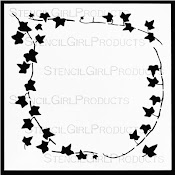
Ivy 6 and Ivy Frame 6 ...

http://stencilgirlproducts.com/new-stencils/view/721
http://stencilgirlproducts.com/new-stencils/view/722

... and Ferns 6 ...

http://stencilgirlproducts.com/new-stencils/view/723

Below is a greeting card cover I made with the Ferns 6 stencil in a technique described in an earlier post (using modeling paste, Distress Inks and rubbing chalk.)  I have used the same technique on a large botanical-themed collage, on gallery-wrap canvas, which I will be taking to my April 15 demo at Monmouth Festival of the Arts ... www.MonmouthFestivaloftheArts.com


Thursday, February 28, 2013

Monoprint using Ivy Stencil Now Available at www.StencilGirlProducts.com

In an earlier post I gave a list of web addresses that give beautiful demos on using a Gelli Plate for making monoprints.  Those other artists do a better job of explaining the process than I could, so I love that they are sharing their know-how online.  Above is a monoprint I made today, using a stencil that has just been released at www.StencilGirlProducts.com -- a 9"X12" ivy stencil, which has a just-released "sister" stencil of the same size:  an ivy frame.  These two 9"X12" stencils have "little sisters" in the 6"X6" size.  Although I used the 6"X6" ivy and the 6"X6" ivy frame stencils in making monoprints today, I like the larger version better for this particular technique.  

Saturday, February 23, 2013

Distress Inks applied directly thru my StencilGirlProducts stencil "Kaleid"

 
My stencil Kaleid -- newly available at www.StencilGirlProducts.com -- was used here with Ranger Industries' Distress Inks, applied through the stencil with an applicator that resembles that old-time shaving brush seen in Westerns.  (These applicators are called "Color Dusters" at www.SkyBluePink.com.) 

Friday, February 22, 2013

Just Posted at StencilGirlProducts.com -- my Stencil "Kaleid"

I'm dying to finish my first attempt at one of the techniques for stencil-use presented at Cindy Powell's blog --

http://cynthiapowell.blogspot.com/

-- but while my bottom coat of paint dries, I'll post two techniques for using Kaleid, the latest of my stencil designs (listed under "New Stencils") posted at www.StencilGirlProducts.com --

Below is a "ghost print" (the second print) I created using Kaleid and a Gelli Printing Plate.
There is a lot of online instruction on this type of monoprinting...

Using stencils is one way in which to use a Gelli Printing Plate or a homemade gelatin printing plate.   

Videos and other tutorial information can be found at these web addresses: 

Homemade Gelatin Printing Plates: 

http://printmakingwithoutapress.blogspot.com/2012/07/new-gelatin-printing-video-by-linda.html  (Note:  This video uses a variation of the technique I use.  The video mistakenly uses the word "stencil" -- and means to use the word "mask."   However, this technique-variation is worth a try -- using an actual stencil.) 

http://printmakingwithoutapress.blogspot.com/p/gelatin-printing-tips.html

(Note:  Lots of helpful info is on the above web page, if you are using a homemade gelatin printing plate.) 


http://cedarcanyontextiles.com/gelatin-printing-with-stencils-lesson-7/

(Note:  The above web address explains using stencils and gelatin printing plates with fabric.) 

youtube.com/watch?v=KRUMcgXK4UY

(Note:  In the above demo, the artist uses slow-drying acrylic extender mixed with her acrylic paints.  This is a common practice among printmakers.  Other options include "open acrylics" and printmaking inks; the latter come in oil-based versions and water-based versions.) 

Gelli Gel Printing Plates (which is what I used in creating the above example): 


****************
Another image I'm posting today is a greeting card cover:
 
 
The Shadow Knows!  To create an image like this, you will need a strong flow of light through a window, or use another source.  Find a way to secure a stencil in a position that results in its shadow being cast.  The shadow can be cast across a flat surface as shown above -- or across someone's face, if you want to create an unusual photo portrait!
 
After taking a photo of the Kaleid stencil's cast shadow, I printed it, cut it out with fancy-cut scissors and glued it to a greeting card cover.  On the lower right (difficult to see, here) I added a simple swirl of glitter glue.